What Are Prediction Markets? Polymarket Explained

Introduction: Prediction Markets in 2026
Prediction markets have moved far beyond a niche crypto experiment. In 2026, they are becoming a serious tool for tracking market sentiment around politics, crypto, sports, macro events, entertainment, and other real-world outcomes.
The biggest example is Polymarket. The platform describes itself as the world’s largest prediction market, where users trade on the outcomes of future events across different categories. Unlike traditional betting platforms, users are not trading against a central house. They are buying and selling outcome-based shares in an open market where prices move based on supply, demand, and new information.
The scale is no longer small. A 2026 report from Bitget Wallet and Polymarket, based on on-chain data from Dune Analytics, stated that Polymarket reached $25.7 billion in trading volume in March 2026. The same report noted that Q1 activity involved 1.29 million wallets, with users expanding beyond crypto into sports, politics, geopolitics, and other real-world categories.
For traders, this matters because prediction markets turn public uncertainty into live prices. For founders, it matters because these platforms show how on-chain products can combine speculation, information discovery, liquidity, and user engagement into one market structure.
In simple terms, prediction markets are becoming a new layer of business intelligence.
What Are Prediction Markets?
A prediction market is a platform where users trade on the outcome of future events. These events can include elections, sports results, crypto prices, economic decisions, legal outcomes, award shows, or major news events.
Instead of only asking people what they think will happen, prediction markets allow users to put capital behind their views. This creates a financial incentive to be accurate. If a trader believes an outcome is more likely than the current market price suggests, they can buy shares. If they believe the market is overpricing an outcome, they can sell or take the opposite side.
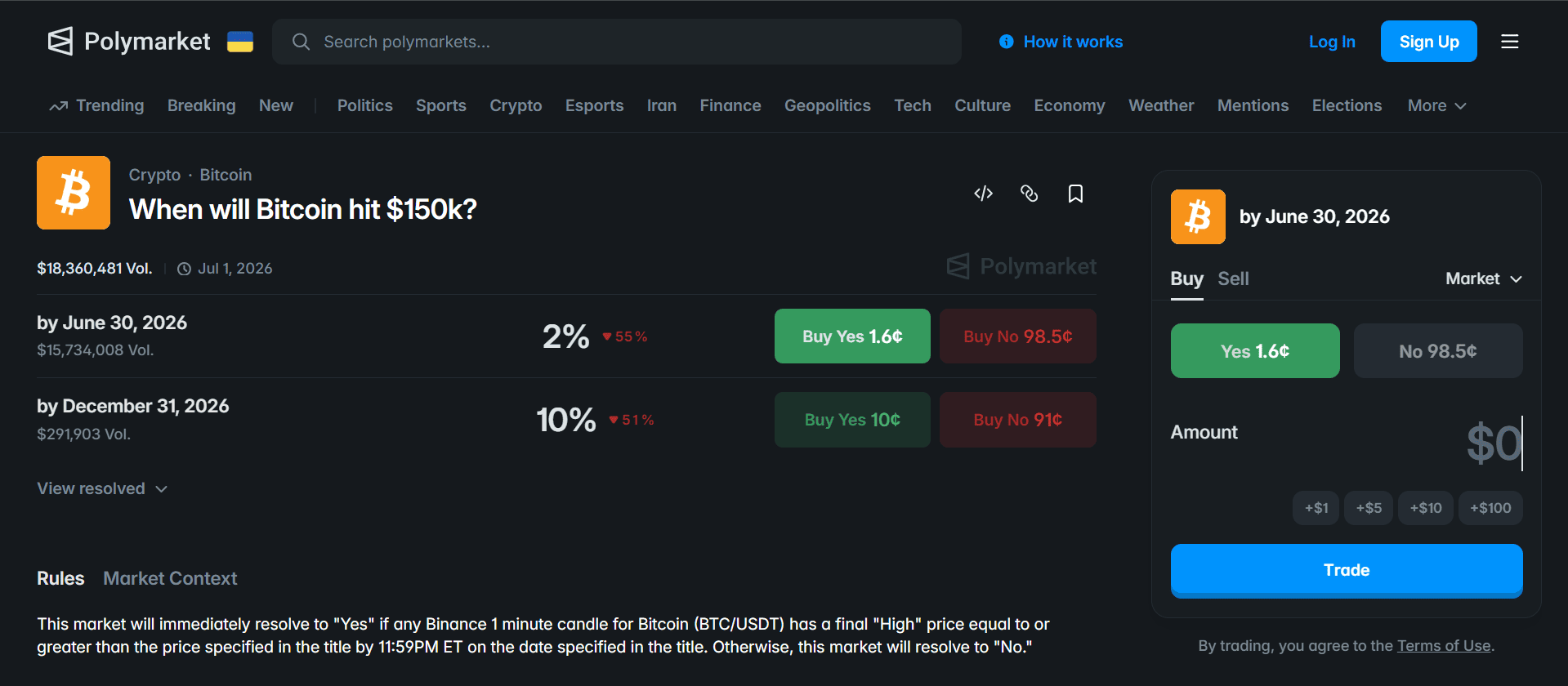
The key concept is that prices reflect probabilities. For example, when a “Yes” share trades at $0.65, it implies the market is assigning about a 65% probability to that outcome. Should the event occur, the winning share is redeemed for $1; if not, it becomes worthless.
This is why prediction markets are often used as real-time probability dashboards. They react quickly to news, polls, market events, social signals, and new information.
How Polymarket Works
Polymarket is built around outcome-based trading. Users buy and sell shares tied to specific questions, such as whether a political candidate will win, whether Bitcoin will reach a certain price, or whether a sports team will win a match.
Polymarket’s documentation explains that the platform uses pUSD as collateral and that every Yes/No pair is fully backed. In the basic model, $1 pUSD creates one Yes share and one No share. The winning share becomes redeemable for $1, while the losing share becomes worth $0. Shares are represented through the Gnosis Conditional Token Framework, using the ERC-1155 standard for on-chain trading and settlement.
This is the core of the Binary Outcome model.
A simplified example:
- A market asks: “Will Bitcoin reach $150,000 by December 31, 2026?”
- A trader buys “Yes” shares at $0.40.
- The market is currently pricing the outcome at roughly 40%.
- If the event happens, each “Yes” share pays $1.
- If the event does not happen, each “Yes” share expires at $0.
The price can move before resolution. This means traders do not always need to wait until the event ends. They can sell earlier if the market moves in their favor or exit to reduce risk if new information changes the probability.
Core Mechanics: The Trade Lifecycle
Prediction markets look simple on the surface, but the backend structure is more advanced. A market needs clear rules, sufficient liquidity, active trading, and reliable resolution.
1. Market Creation
A prediction market starts with a specific question and defined resolution criteria. The market must make clear what outcome counts as “Yes,” what outcome counts as “No,” and what source or rule will determine the final result.
This step is important because weak market wording creates disputes. A good market must be precise, measurable, and tied to a verifiable event.
For example, “Will Bitcoin rise?” is too vague. A stronger market would be: “Will Bitcoin trade above $150,000 on Coinbase before December 31, 2026?”
2. Liquidity Provision
After a market is created, it needs liquidity. Without sufficient Liquidity Depth, users may face wide spreads, poor execution, and unreliable pricing.
Liquidity allows traders to enter and exit positions more efficiently. It also helps the market price reflect a more accurate probability.
A low-liquidity market can be noisy. A high-liquidity market is usually more useful as a sentiment indicator.
3. Trading
Once the market is active, traders buy and sell outcome shares. On Polymarket, users trade directly with other users through a peer-to-peer order book, rather than against a central bookmaker or house.
Prices change as traders react to new information. News, polls, regulatory decisions, market volatility, sports results, and public statements can all affect pricing.
This is where prediction markets become useful for analysis. They show how financially motivated participants update probabilities in real time.
4. Oracle Resolution
When the event ends, the market needs to be resolved. Polymarket uses the UMA Optimistic Oracle for resolution. The process generally includes an outcome proposal, a challenge period, and, if needed, a dispute process. If the resolution is accepted, winning shares become redeemable for $1 pUSD.
Polymarket’s help center also explains that markets are resolved according to pre-defined market rules. When a market is resolved, holders of winning shares receive $1 per share, losing shares become worthless, and trading is no longer possible.
For traders, this is one of the most important parts of the model. The quality of on-chain resolution determines whether users trust the market enough to trade size.
Key Features of Polymarket
Decentralized Market Structure
Polymarket is not designed like a traditional sportsbook where the platform acts as the house. Users trade against other users, and prices are formed by market supply and demand. This creates a more exchange-like structure where market participants decide probabilities through trading activity.
Transparent On-Chain Settlement
Polymarket’s documentation states that trades are settled through smart contracts and that positions are recorded on-chain. This gives users more transparency compared with closed platforms where settlement logic is handled internally.
For Web3 users, this is a major part of the value proposition. The market does not only show a price; it shows activity that can be verified.
Incentivized Accuracy
Prediction markets reward users for being correct, not for being popular. A trader who identifies a mispriced outcome can profit if the market later adjusts or if the final result confirms their view.
This is what separates prediction markets from social media sentiment. Opinions are easy to post. Prediction markets require financial commitment.
Real-Time Market Sentiment
For analysts, prediction markets can act as live sentiment feeds. Instead of waiting for polls, reports, or expert commentary, users can watch how market probabilities change as new information enters the system.
This does not mean prediction markets are always correct. It means they provide a live view of where financially motivated traders are placing their conviction.
Profitability and Trading Strategies
Prediction markets attract traders because they create opportunities around information, timing, and probability.
The simplest strategy is directional trading. A user buys “Yes” or “No” when they believe the market price does not reflect the true probability of an event. If the market moves in their favor, they can sell before resolution or hold until payout.
More advanced traders use prediction markets for hedging. For example, a crypto trader exposed to Bitcoin volatility may use a prediction market to hedge against a specific price outcome. A founder or investor watching regulatory risk may monitor markets tied to policy decisions, approvals, lawsuits, or election outcomes.
Prediction markets can also support sentiment analysis. Traders may not always place a trade, but they can use market prices to understand how public expectations are shifting around a specific event.
Common trading approaches include:
Event-driven trading: Taking positions before elections, sports events, legal decisions, or crypto milestones.
News reaction trading: Entering or exiting positions as new information changes the market’s probability.
Hedging: Using prediction markets to offset exposure to political, market, or regulatory outcomes.
Sentiment tracking: Monitoring probabilities as a business intelligence tool without necessarily trading.
Stablecoins also play an important role in this ecosystem. Polymarket’s documentation states that pUSD is used as collateral, with winning shares redeemable for $1 pUSD. This stable collateral model helps simplify pricing because traders can evaluate outcomes in dollar terms rather than volatile token units.
How Polymarket Makes Money
The economics of prediction markets depend heavily on trading activity, market depth, and user retention.
A platform like Polymarket benefits when more users trade, more markets become active, and liquidity improves. Analysis of prediction market business models shows that transaction fees can create a volume-driven revenue structure, where revenue grows as users participate in active markets.
Liquidity is especially important. Higher participation can improve price stability, tighten spreads, increase execution speed, and support more frequent trading. This creates a stronger marketplace for both users and the platform.
From a founder’s perspective, this model is important because it shows how a Web3 product can create recurring engagement. Users return not only because of speculation, but because real-world events keep changing.
That is a strong retention loop.
Why Prediction Markets Matter for Traders and Founders
For traders, prediction markets offer a different type of exposure. They are not simply trading assets like BTC, ETH, or stocks. They are trading outcomes. This makes prediction markets useful for situations where price, probability, news, and timing are closely connected.
For founders, prediction markets show how information markets can become consumer products.
Polymarket’s growth in 2026 suggests that users are not only interested in trading tokens. They are also interested in trading views on real-world outcomes. The March 2026 data showing $25.7 billion in volume and 1.29 million Q1 wallets points to a market that is moving toward repeated use across multiple categories.
This is why prediction markets are becoming increasingly important as business intelligence tools. They can help teams monitor sentiment around:
- Regulatory decisions
- Token launches
- Election outcomes
- Sports and entertainment events
- Crypto price milestones
- Macro and geopolitical risks
For P2B, the key takeaway is clear: prediction markets are not only trading venues. They are live probability engines that convert public uncertainty into measurable market data.
Main Risks of Prediction Markets
Prediction markets are useful, but they also carry risks.
The first risk is liquidity risk. If a market has low liquidity, prices may not reflect reliable probabilities. Traders may also struggle to enter or exit positions efficiently.
The second risk is resolution risk. If market rules are unclear or the outcome is difficult to verify, disputes can happen. This is why strong market wording and reliable oracle resolution are essential.
The third risk is regulatory risk. Prediction markets are attracting more attention from regulators, especially when markets involve politics, public officials, sports, or sensitive geopolitical events. Recent reporting shows that prediction markets such as Polymarket and Kalshi have faced increased scrutiny from U.S. officials, including concerns about insider information and government employee participation.
The fourth risk is information asymmetry. Traders with faster access to accurate information may have an advantage over casual users. This is common in many markets, but it is especially relevant when outcomes depend on breaking news.
Traders should treat prediction markets as speculative instruments and review market rules before entering a position.
Conclusion
Prediction markets allow users to trade on future outcomes and turn uncertainty into live market prices. Polymarket has become the most visible example of this model by combining crypto infrastructure, stablecoin collateral, peer-to-peer trading, conditional tokens, and oracle-based resolution.
For traders, prediction markets create a new way to express views on politics, crypto, sports, macro events, and real-world outcomes. For founders, they show how Web3 platforms can build engagement around information, not only assets.
From P2B’s perspective, prediction markets in 2026 should be viewed less as simple betting platforms and more as information markets with trading functionality. Their value depends on liquidity depth, clear market rules, reliable oracle resolution, and transparent pricing.
For anyone using platforms like Polymarket, the priority should be understanding the market structure before entering a position. Traders need to review event rules, resolution criteria, liquidity, and risks. In 2026, Polymarket is no longer just a crypto-native product. It is becoming an institutional-grade indicator for how the market prices uncertainty in real time.
 Wow!
Wow! Mmm
Mmm Hmm
Hmm Meh
Meh Pff
Pff